Tuesday, October 27, 2015

New stuff

Been a while since I posted anything due to other imperatives, but I was recently able to get back to the freezer to work on some really, really cool specimens. Will post more as I go, but here are a few of the highlights.

Leopard shark (Triakis semifasciata)

This specimen is incredibly beautiful. The colors and patterns were amazing. I kept the head to prepare the skull and we skinned it. Part of the skin and a few vertebrae will go back to the aquarium that gave the specimen and will be used for educative purposes.

Soup of the day!

Plenty of cool specimens: batfish, pineapplefish, porcupinefish, trumpetfish, stonefish, dentex head and more.

Pelagic stingray (Pteroplatytrygon violacea), Mediterranean moray (Muraena helena) and a tetraodontiform

We actually processed several stingrays as I recently got a batch of them from a local fisherman recently. Some specimens will go to other researchers.

 Pineapplefish (Cleidopus gloriamaris)

These fish are incredible. I'm planning to keep the entire dermal skeleton and it was not easy to gut them without damaging the fish or removing the scales.

Mediterranean moray head

Mediterranean moray head (dissected)

It's incredible how small the skull actually is once all the fat and muscle is removed. These fish also have an incredible anatomy, and of course we saved the pharyngeal jaws (check this out: http://www.wired.com/2014/04/absurd-creature-of-the-week-this-eel-fires-extra-alien-jaws-out-of-its-throat/)

Estuarine stonefish (Synanceia horrida)

Now this is one of the coolest specimens we had. I love scorpaeniforms so it was fantastic to work on a stonefish. Amazingly, the bones of this specimen had a very noticeable blue/green color (not unlike some needlefish), not sure if the complete skeleton is like that though, we'll see.

Tuesday, June 30, 2015

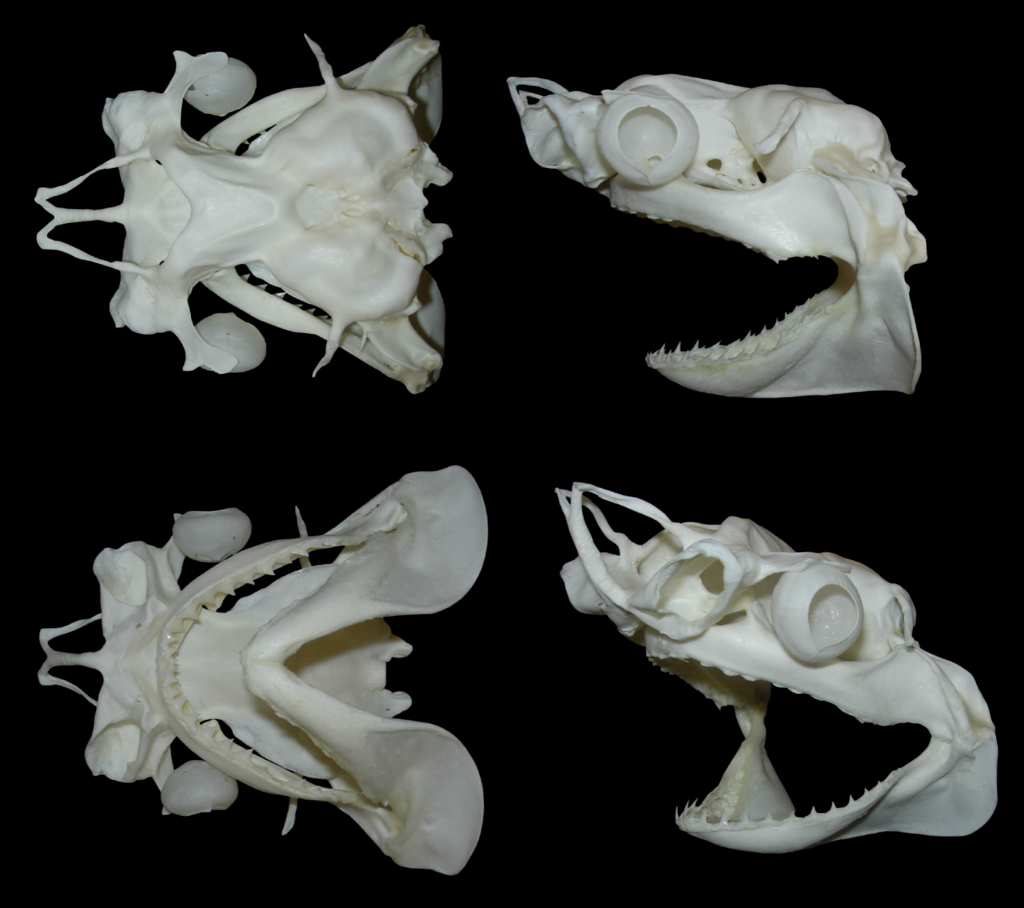
Mako shark skull

Here's the recently completed skull of a shortfin mako shark (Isurus oxyrinchus). It's not very big, but I am very happy with how it turned out. I kept warping to a minimum and it whitened really well.
It's the first lamniform I work on, and the rostrum is very impressive in these sharks.

Profile view. The sclerotic capsule is strongly mineralized in this species.


Side view.


Dorsal view.
Looking forward to work on some other interesting species I have in the freezer now, but that may not be before a while due to a rather busy schedule.

Monday, May 25, 2015

Portuguese fish!

A few weeks ago I attended the 4th IAFSB (Interdisciplinary Approaches in Fish Skeletal Biology) meeting in Tavira, Portugal. I had a fantastic time there with great science and great people, and it came as a very nice surprise to see so many shark people there.
A few of us also took the opportunity to go to the local fish market see if we could find some cool fish to take home, which was really funny because for once I was not the only weirdo looking for heads or strange species. We saw loads of black and silver scabbardfishes and really wish I had gotten some of these, but I was already loaded with the cartilaginous stuff. Here's a few pictures of the specimens I brought back.

Torpedo sp. and Mustelus mustelus (? could be M. asterias, not quite sure on this one).

The torpedo skull on the left is very damaged: the fishermen cut through the jaws, one hyomandibular, and they also damaged the nose area (the antorbital cartilages are entirely missing). I still took it since it's the first time I come across torpedoes and it should still be useful as a practice specimen since I'm not very familiar with their skeletal anatomy.

 Couple of skates. The big one on the left is Raja microocelata and still have to ID the two smaller ones, probably Leucoraja something.
Unidentified torpedo head (T. marmorata or T. torpedo) and whole T. torpedo

The head is either from T. marmorata or T. torpedo. The first specimen had already been skinned and cut in pieces so ID is difficult, and they had both species at the market. The atlantic torpedo (Tetronarce nobiliana) is also present in the area, but this species is much bigger and usually found at greater depths. The complete specimen should make a very cool skeleton, unfortunately the pelvic fins are a little damaged.

Dissection time!
Photo: Callie Crawford

Since none of us planned to be working on fresh specimens we had to improvise a bit. I had to buy several kilos of salt to prep them for the return trip. The other guys used some kind of cheap vodka and big plastic jars for their stuff. Wish I had a picture of this since it was quite funny. But the best part was trying to dissect fish using a table knife and nail clipper. Not the easiest way to do it!

Busted torpedo skull close up.
Photo: Callie Crawford

Everything is now safely stored in the freezer. I'll post WIP pictures here as I get around working on them.


Saturday, April 18, 2015

Blacktip update

Quick update on a couple of fishy bits. The blacktip shark skull is now finished, and waiting for the rest of the skeleton. As I'm currently quite busy with other stuff it might be a while before I get the time to finish it, but most of it is now completely clean, and just needs to be dried properly.

Carcharhinus melanopterus skull, finished.

Partial angelfish skeleton (probably Pomacanthus sp.). The pins are holding the fins in place while they dry.

Mako shark (Isurus oxyrinchus) drying. The basihyal is missing on the picture.

Couple of chondrichthyan parts: Raja asterias pelvic fins, Carcharhinus melanopterus hyoid arch, and Squalus acanthias skull and vertebrae.

Monday, February 23, 2015

Toothy snakes

Even though I'm mostly working on fish stuff these days, I'm still working with herps sometimes which were the focus of my collecting interest when I first started cleaning skulls and skeletons. Among these, I've always been especially drawn to groups such as crocodilians, varanids and boids. I've always loved constrictor snakes and I currently have two live pythons at home, so I love them both live and skeletonized. As they're popular as pets, a lot of people are breeding a huge variety of species, so it's not that hard to get some captive bred specimens to work on, and due to their size, they can make very impressive specimens.

My two roommates: Otto (Python regius) and Raoul (Morelia bredli). Pictures are a bit old so they're a bit larger now. And yes, I love silly names.

Two species in particular have always attracted my attention for a variety of reasons: the green tree python and the emerald boa. First, they are absolutely beautiful snakes and make up a really cool example of convergent evolution. They're pretty high maintenance in captivity though, and quick biters as well, so never considered getting some live ones. Another thing they share is a fantastic looking skull.

 Emerald boa skull (Corallus caninus)

Green tree python skull (Morelia viridis)

Although they don't grow to very large sizes, they share the longest teeth found in non-venomous snakes. You just don't want to get bitten by one of these guys.


Sunday, February 15, 2015

Fishy bits

Quick update on the blacktip (here)! I'm finally getting there. Still have to clean about half of the gills, but otherwise all pieces are cleaned, whitened, and most are dried already. I should have everything clean and dry by the end of the month so I can start putting the shark back together.

Dorsal and pectoral fins. As with the smooth-hound skeleton, I decided to keep the skin on most of the fins to protect the ceratotrichia.

Caudal fin, I used the same approach here.

And a couple of pictures from other projects:

Three catsharks (Scyliorhinus canicula) skulls in the cleaning process.

Degreasing a black grouper sull (Mycteroperca bonaci). This guy is incredibly greasy and will probably require multiple acetone soaks before whitening and final assembly.

Friday, January 16, 2015

Funky wet specimens

Happy new year!
As I was sorting through some pictures the other day, I found a few funny ones of various wet specimens I prepped a long time ago. Although my main interest is osteology, I also keep many specimens in fluid, especially when I have several specimens of the same species to work on.
So here are a few!

Musky octopus (Eledone moschata)

Musky octopus (Eledone moschata). Love the Cthulhuesque look of this one.

 Common cuttlefish (Sepia officinalis). I used blue tinted acrylic with this one, which soon after dissolved into the ethanol, turning the liquid blue. So use glass if you're trying something like that.

Monkfish (Lophius piscatorius)

 Remora (Echeneidae) sucker. This is actually a modified dorsal fin (Britz & Johnson, 2012)

Stargazer snake eel (Brachysomophis cirrocheilos)

Apron ray (Discopyge tschudii)

 Ref: Britz R, Johnson GD. 2012. Ontogeny and homology of the skeletal elements that form the sucking disc of remoras (Teleostei, Echeneoidei, Echeneidae). Journal of Morphology 273: 1353-1366.