Showing posts with label Jaws. Show all posts

Saturday, June 4, 2016

Current projects


Been a while since I posted anything here.
Still busy with our upcoming website, but in the meantime we have been working on a couple of really interesting projects, which are almost completed now, but I'll just post some early pictures for now.

We have been asked to clean a full shark and skate skeletons for a french natural history museum. This is a really exciting opportunity, and they look fantastic so far. The species are a school shark (Galeorhinus galeus) and undulate ray (Raja undulata). Both are male specimens caught off the coast of Brittany in France. The plan is to have them displayed next to their taxidermied versions, which were recently completed by Bernard Bourles, an excellent ichthyotaxidermist (his website can be found here: http://www.poissons.net/).

Galeorhinus galeus. This specimen is a male around 1.20 m long.

Dissection of the gills, this part needs to be done very carefully as not to damage the delicate branchial rays and extrabranchials, which are visible on top of the gills here.

Raja undulata, male specimen as well. This is the largest skate I've been working on so far.

As with most skate, many parts of the body are covered with various kind of spines and thorns. These are located on the pectoral fins and make handling such a specimen a bit tricky as they are extremely sharp.

The tail is also covered with them.

Massive jaw musculature.

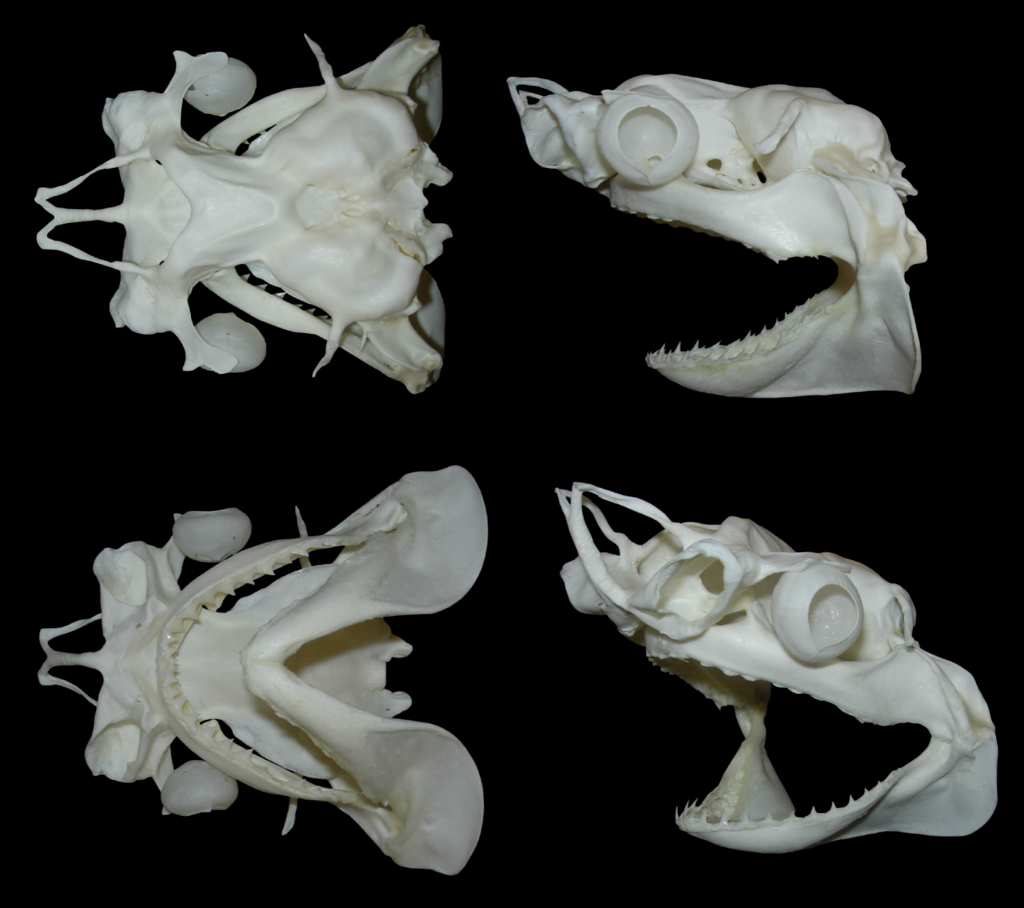
A couple of other projects we're currently working on is another full shark skeleton for a british aquaria, which should be completed very soon, and a few other critters as well, of which the most impressive is certainly this bowmouth guitarfish.

It's a small specimen that died in captivity. It's in good condition overall despite several issues with the skeleton, and shows some truly incredible morphological features.

Detail of the dentition. While many species have funky teeth, this species has always striked me as one of the most incredible chondrichthyan dentition.

Top view of the neurocranium during preparation. The cartilage was a bit damaged in the rostral area, but once again, really impressive thing. It's massive, and really looks like some bizarre hammerhead shark.

That's it for now, pictures of the finished specimens will follow soon!


Saturday, April 18, 2015

Blacktip update

Quick update on a couple of fishy bits. The blacktip shark skull is now finished, and waiting for the rest of the skeleton. As I'm currently quite busy with other stuff it might be a while before I get the time to finish it, but most of it is now completely clean, and just needs to be dried properly.

Carcharhinus melanopterus skull, finished.

Partial angelfish skeleton (probably Pomacanthus sp.). The pins are holding the fins in place while they dry.

Mako shark (Isurus oxyrinchus) drying. The basihyal is missing on the picture.

Couple of chondrichthyan parts: Raja asterias pelvic fins, Carcharhinus melanopterus hyoid arch, and Squalus acanthias skull and vertebrae.

Saturday, October 11, 2014

Blue shark skull

This post is a bit overdue since this specimen has been completed for almost a year now, but I still wanted to write a few lines about it. It was my first large shark skull (and one of my first shark skulls for that matter, since I only started experimenting on numerous catshark specimens a few months later), and I made several mistakes in the process which I'll discuss a bit here.

I found this specimen quite unexpectedly while out to buy some food during the summer of 2013. I always check the fish department as well in case they might have anything of interest, and got really excited when I noticed the large shape on the stall. Although it's meat is sold on a regular basis around here (I'm located on the Mediterranean coast) it was the first time I saw the head in a shop, and the guys there were nice enough to give me the head for free.

Blue shark (Prionace glauca) head.

Close up on the snout showing the ampullae of Lorenzini. The medial rostral cartilage is also visible through the skin.

Dissection of the head, with palatoquadrate and right optic capsule exposed.

The first mistake I made with this specimen was to attempt a complete dissection of the head. While it can be done, it often leads to broken structures in the skull, since in some areas the skin is a lot tougher than the cartilage underneath, especially around the rostrum and orbital processes. Doing so, I damaged one of the preorbital processes, which are fairly developed in this species.
The second mistake was to apply too much heat to the jaw which separated at the joints. Fortunately, the teeth didn't fall out, which is also a common occurrence when too much heat is applied. This is why you can't clean shark jaws by boiling them as Quinn is doing in Jaws.

Re-articulation of the jaw joints.

The jaws can be glued back in place, and on large skulls I use wire as well for additional strength. Even then, the jaws will be much more fragile and delicate than if the ligaments are preserved. The palatoquadrate and meckel's cartilage are carefully drilled and wired with brass wire and glued back together. The same process can be used for the hyomandibulars and to glue the jaw to the chondrocranium. On large specimens, I prefer to remove the jaw from the chondrocranium for proper cleaning. This way I can also apply heat to the chondrocranium without damaging the jaws.

Gluing the hyomandibulars back in place on a blacktip reef shark (Carcharhinus melanopterus).

 Another issue with the blue shark is the tendency of the chondrocranium to warp a lot as it dries. Freeze drying might reduce this issue, but every specimens I've been able to see so far displayed a high degree of distortion.

Dorsal view of a blue shark skull, showing important distortion.

Anyway, it was still a very interesting specimen to work on. I hope to get my hands on a second one later one so I can clean it properly without repeating the same mistakes.

The finished specimen. I also kept the ceratohyals and basihyal and might glue them back later.


Friday, August 8, 2014

Pink teeth

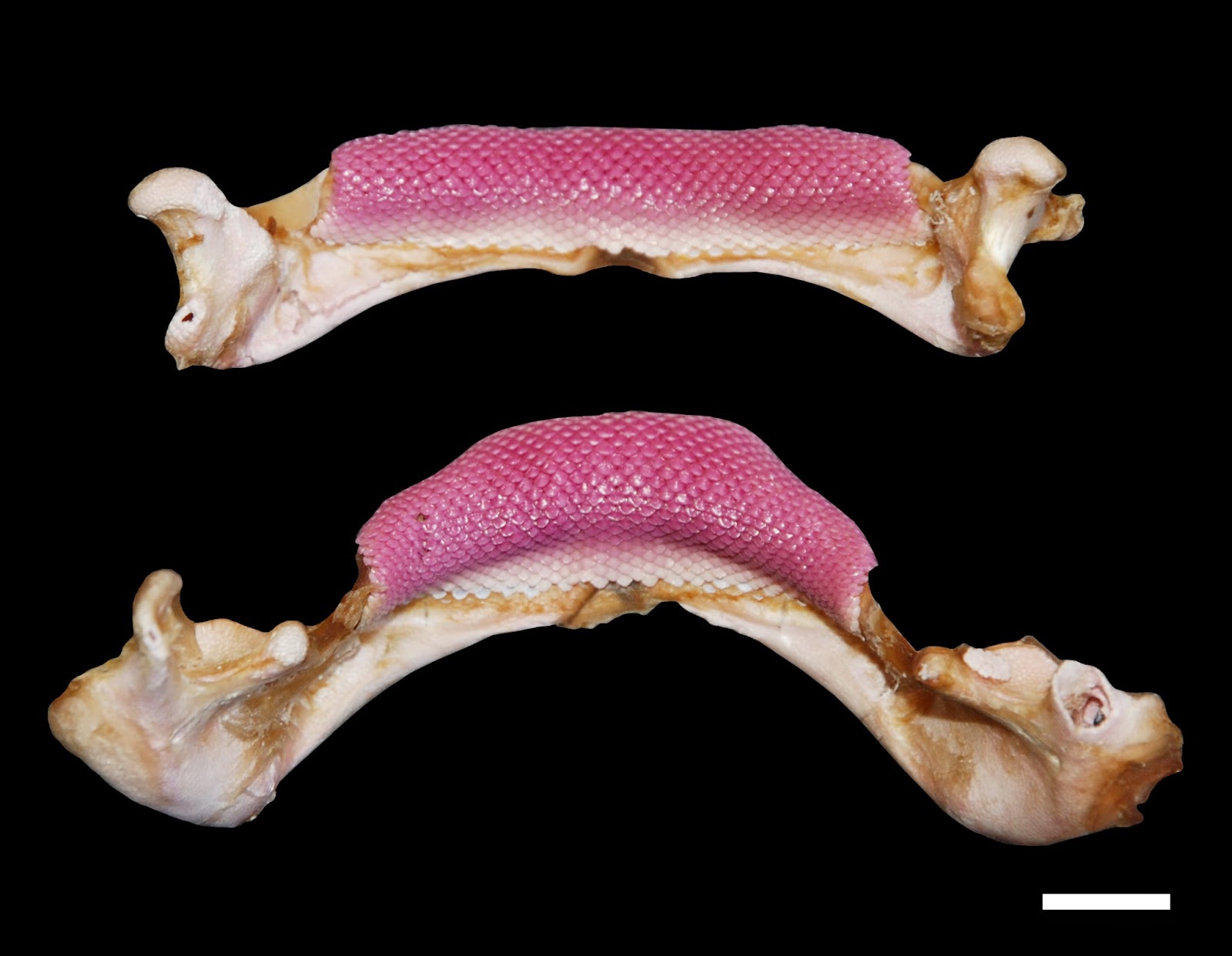
I recently came across this set of jaws from a Tortonese's stingray (Dasyatis tortonesei, which is probably invalid by the way) and was very surprised by the pink color of the teeth. It apparently not an uncommon occurrence in this species and is supposedly related to their diet, but I don't have any info/idea so far of what may be causing the the teeth to turn pink like that. For the little story, fishermen catching these apparently call them "whore rays" since they look to be wearing way too much lipstick.

D. tortonesei jaw, labial view. Scale bar: 1 cm

 D. tortonesei jaw, labial view. Scale bar: 1 cm

And while doing my regular fish shop round the other day, I found a couple of these guys.

 Red bandfish (Cepola macrophthalma) heads.

They are red bandfish, a small burrowing species found mainly in the eastern Atlantic and Mediterranean sea. First time I saw some despite them being regularly caught for those. They should have nice little skulls, and I might try to clear and stain a couple as well, more on that later.